
Customer Success Story Video Production
Many customer success story video productions are treated as nothing more than a customer interview. But the truth is, an effective customer success story video that isn't structured properly becomes content that goes unwatched — and unwatched content never converts into sales. At Vusto, in the projects we've delivered, we see clearly that the single biggest differentiator is "how the story is told." In this article, we walk you through, step by step, how a version of a customer success story video that actually works gets made.
The Power of Customer Success Story Videos
In the success story projects we've delivered at Vusto, the most common issue we run into is that the customer's story isn't clear. When the right questions aren't asked before filming, the resulting video fails to build an emotional connection and ends up as content that merely informs. For example, in the project we produced for Weir Minerals, the initially planned content was a classic customer-experience narrative. But through revisions we made before filming, we restructured the story into a "problem -> solution -> result" format, and the video's performance increased significantly. Customer success story videos go beyond simply being a reference. These videos show the real-world impact of the solution your brand offers. When viewers see people facing similar problems achieve success with your company's products or services, they connect more easily and their trust in your brand grows. As one of the most effective forms of social proof, these videos remove doubts in potential customers' minds, build an emotional connection, and ultimately increase conversion rates. A satisfied customer sharing their experience is far more convincing and memorable than a brand praising its own product.
Step-by-Step Customer Success Story Video Production Process
In our projects, we look for answers to these 3 questions: - What problem was the customer facing? - How was this problem solved? - What changed as a result? Without this structure, a video gets watched but not remembered. Creating an effective customer success story video is possible with careful planning and a professional approach. Here's the step-by-step process to follow:
1. Strategy and Planning
- Defining the Goal: What do you want to achieve with your video? Attract new customers, highlight a specific product feature, or boost brand awareness? Your goals will shape the entire process.
- Choosing the Right Customer: Identify customers whose story is the most compelling, whose results are the most concrete, and who align best with your brand. It's important that the customer is comfortable on camera and can tell their story fluently.
- Creating a Story Outline: Prepare an outline covering the key stages — the problem the customer faced, how they discovered your solution, the implementation process, and the concrete benefits they achieved.
- Budget and Timeline: Set a budget and a realistic timeline for filming, editing, and publishing.
2. Script and Question Preparation
- Key Messages: Identify the core messages the video needs to convey and the values that set your company apart.
- Pre-Interview with the Customer: Hold a detailed pre-interview with the customer before filming to understand their story in depth. This will help you prepare the right questions.
- Creating a Question List: Prepare open-ended questions that let the customer tell their story in a natural flow. Instead of a script, provide a framework the customer can speak within, in their own words.
3. Pre-Shoot Preparations
- Location Selection: Make sure the shoot location fits your brand's image, is well-lit, and quiet. The customer's own workplace is often the most authentic option.
- Equipment and Technical Preparation: Make sure professional camera, lighting, and audio equipment is ready. Don't overlook details like spare batteries and memory cards.
- Permits and Logistics: Secure all necessary permits for filming. Plan logistics like transportation and accommodation for the customer and crew.
4. Shoot Day
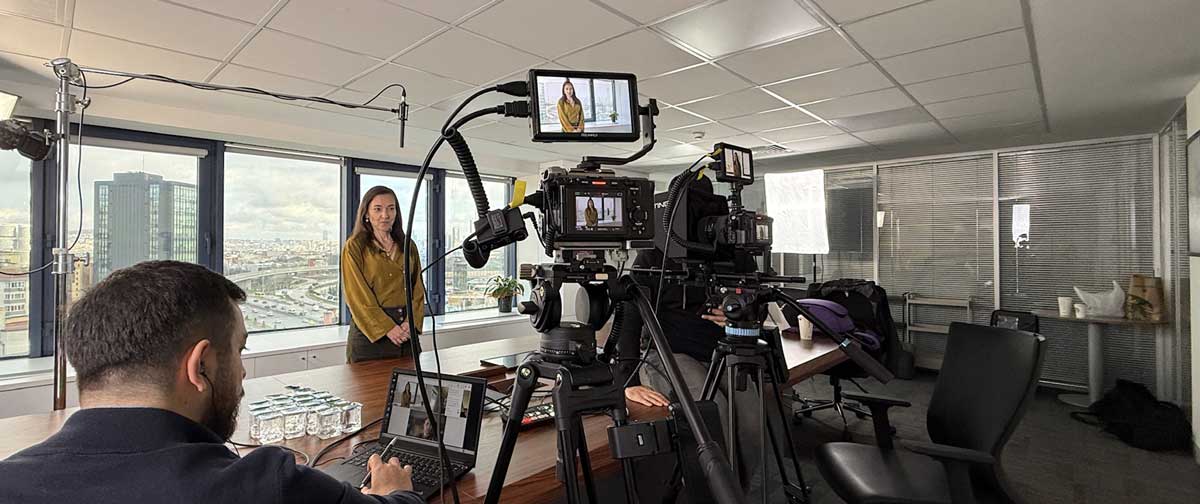
We typically use 2 cameras during filming. One camera captures the main interview, while the other films the speaker from a different angle, and afterward a handheld camera gathers detail shots (cutaways, b-roll). The video production stage consists of exactly this — but these steps are what make it possible to create a smooth, dynamic structure during editing.
- Professional Crew: Working with an experienced director, camera operator, and sound technician is the key to quality.
- Communicating with the Customer: Make sure the customer feels comfortable. Explain the process to them and encourage them to be natural when answering questions.
On one project, our customer was quite nervous during filming and struggled to speak naturally. In that case, we paused filming, switched to a conversational format, and helped them relax before recording again. This approach resulted in a much more natural and compelling delivery.
- Additional Footage (B-roll): Capture additional footage (b-roll) of the customer using your product or service, in their workplace, or engaged in related activities. This footage adds dynamism to the video and enriches the story.
5. Post-Production and Editing
- Editing: Edit the captured footage to match the story flow. Highlight the most compelling moments and key messages.
- Color Grading and Sound Mixing: Apply color grading to enhance the video's visual quality, and complete the mixing process to ensure the audio is clear and easy to understand.
- Graphics and Music: Add intro/outro graphics, text overlays, and a suitable royalty-free background track that fits your brand identity.
- Approval Process: Share the draft video with your customer and the relevant internal departments to gather feedback and make any necessary revisions.
6. Publishing and Marketing
- Platform Selection: Publish your video on your website, video platforms like YouTube and Vimeo, and your social media channels.
- SEO Optimization: Boost your video's visibility by optimizing its title, description, and tags with relevant keywords.
- Promotion Strategies: Promote your video through email marketing, social media campaigns, and other digital marketing channels.
Frequently Asked Questions
Does a customer success story video really drive sales?
Yes. A well-structured success story video provides the "trust" factor that potential customers need most. Videos featuring real customer experiences, in particular, convert far better than classic promotional content.
At Vusto, we consistently observe that these kinds of videos significantly speed up decision-making, especially during the proposal process.
How long should a success story video be?
Generally, 2–5 minutes is the ideal length. This duration keeps the message clear without losing the viewer's attention.
However, depending on the project, we also produce shorter social media versions, so the content can be used with maximum efficiency across different platforms.
How long does the shoot process take?
Most customer success story videos can be filmed in a single day.
However, the planning (pre-production) process before filming is just as important as the shoot itself. If the right story isn't structured at this stage, the video will lose its impact no matter how well it's shot.
That's why we plan the entire process end-to-end.
What do we need to prepare for the shoot?
Generally, 3 things are enough:
- The person giving the interview
- The shoot location
- The main topic of the story
We manage all the remaining technical and creative processes.
If you'd like, we can also hold a short briefing together before filming to determine the most accurate story flow.
What happens if the customer isn't comfortable speaking on camera?
This is one of the situations we encounter most often.
That's why we conduct Customer Success Story Video Production not as a classic "question-and-answer" format, but as a more natural conversational flow.
If needed, we do a short warm-up before filming to help the person relax. This results in a much more natural and genuine delivery.
How many people work on a video production process?
It depends on the project's scope.
A 3–4 person crew is enough for simple shoots, while larger productions may require a crew of 8–10.
What matters isn't the number of people, but building the right crew structure.
How long does the post-production process take?
Including editing, color grading, and sound design, the process generally takes 1–2 weeks.
This is where the video's rhythm, emotion, and watchability are shaped. In fact, this is where the most critical part of the work actually happens.
Are these videos only used on the website?
No. In fact, they show their biggest impact through multi-channel use.
You can get maximum value by using the same video:
- On your website
- On LinkedIn
- In ad campaigns
- In sales presentations
We typically plan our projects around this kind of multi-use scenario.
What determines Customer Success Story Video Production pricing?
Prices are determined by the following factors:
- Shoot duration
- Crew size
- Number of locations
- Equipment to be used
- Post-production scope
That's why, instead of giving a flat price, the right approach is to plan specifically for your project.
How can we tell if this is the right kind of project for us?
The most reliable approach is a short consultation.
We can listen to your needs and tell you clearly whether this is a project that would genuinely add value for you.
If you'd like, you can get in touch with us to evaluate your project together.
Customer success story videos are an invaluable marketing tool that strengthens your brand's credibility, persuades potential customers, and boosts your sales. By following this step-by-step guide, you can create professional videos that showcase your company's value and customer satisfaction in the most effective way.